Ostkrieg by Stephen G. Fritz
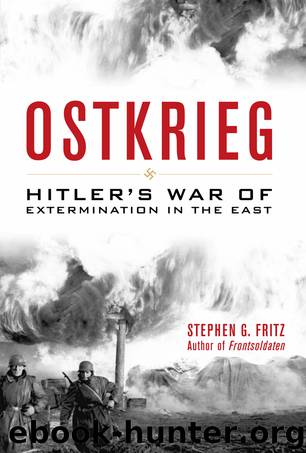
Author:Stephen G. Fritz
Language: eng
Format: epub, mobi
Publisher: The University Press of Kentucky
Published: 2011-07-21T16:00:00+00:00
It was a dramatic moment, as all in attendance and those listening on the radio were well aware. After two weeks of mourning the catastrophe at Stalingrad, Joseph Goebbels on the evening of 18 February 1943 addressed a handpicked audience of the party faithful in Berlin’s Sportpalast, itself emblazoned with rousing slogans (“Hail, Victory!” “Führer command, we’ll follow!” “Total War, Shortest War!”). After praising the spirit of the defenders of Stalingrad, Goebbels promised “an unvarnished picture of the situation.” The events in the east, he admitted, had been a serious blow, and Germans had to be made aware of the possibility of defeat, of the threat from the “Bolshevist-capitalist tyranny” of the Jews. Describing precisely what the Germans had already done to the Poles, Jews, and Russians, Goebbels raised the specter of “the liquidation of our educated and political elite,” “forced labor battalions in the Siberian tundra,” and “Jewish liquidation commandos.” “We must act quickly and radically,” he stressed, then, adroitly exploiting class antagonisms with effective populist rhetoric, outlined a series of measures designed to root out luxury and complacency among the German population. Making it clear that worker outrage was the driving force behind these actions, he blasted privileged elites, those who persisted in a frivolous lifestyle, and those who indulged in comfortable entertainments. Invoking a “community of fate,” Goebbels demanded that radical methods be employed to achieve results. Having stoked the populist resentments of his listeners, the propaganda minister then posed a series of ten provocative questions, at the end of each of which he asked, “Do you want total war?” At each question, fourteen thousand frenzied voices rang out in unison to affirm loyalty to Hitler and the war effort. As his speech, which had been interrupted more than two hundred times with shouts of approval and thunderous applause, moved to its climax, Goebbels screamed, amid a wild tumult and choruses of approval, “Do you want total war? Do you want it . . . more total and more radical than we can even imagine it today?” As the crowd erupted once more in hysteria, Goebbels closed by invoking the words used by the nationalist poet Theodor Körner in the struggle against Napoléon, “Now people, arise—and let the storm burst forth!”40
Although generally well received at the time, especially by the working class, which understood and approved the element of egalitarian social revolution implicit in it, the speech marked the culmination, not the beginning, of a process to reorient the German war economy and society—a process itself that was only indifferently successful. Long convinced that only “the total commitment of all of our resources and reserves” could produce victory, Goebbels had argued at least since the first winter crisis in December 1941 for radical measures to mobilize the German population. Although some steps had been taken in early 1942 to reorganize the war economy, the stabilization of the front, the success of Sauckel’s labor roundups, the opposition of the Gauleiter, and the military triumphs of the summer all undermined the effort at a comprehensive mobilization of the Reich’s resources.
Download
This site does not store any files on its server. We only index and link to content provided by other sites. Please contact the content providers to delete copyright contents if any and email us, we'll remove relevant links or contents immediately.
The Radium Girls by Kate Moore(12027)
100 Deadly Skills by Clint Emerson(4924)
Rise and Kill First by Ronen Bergman(4788)
The Templars by Dan Jones(4689)
The Doomsday Machine by Daniel Ellsberg(4490)
The Rape of Nanking by Iris Chang(4211)
Killing England by Bill O'Reilly(4001)
Stalin by Stephen Kotkin(3965)
Hitler in Los Angeles by Steven J. Ross(3946)
12 Strong by Doug Stanton(3548)
Hitler's Monsters by Eric Kurlander(3341)
Blood and Sand by Alex Von Tunzelmann(3203)
The Code Book by Simon Singh(3189)
Darkest Hour by Anthony McCarten(3129)
The Art of War Visualized by Jessica Hagy(3007)
Hitler's Flying Saucers: A Guide to German Flying Discs of the Second World War by Stevens Henry(2754)
Babylon's Ark by Lawrence Anthony(2676)
The Second World Wars by Victor Davis Hanson(2524)
Tobruk by Peter Fitzsimons(2516)
